
The most common question I receive here at Comic Book Secrets is “how much are my comic books worth?” Your comics my be worth a lot, but at the risk of making some people angry, the majority of the collections I get asked about are not going to sell for very much. In fact, there are 3 brutal truths you must know about comic book collections, and I urge you to please read the entire article.
Brutal Truth #1 – Condition is Everything and Your Comics Aren’t Near Mint
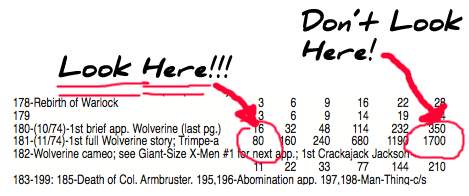
It’s only human nature that when you look up your comic book values in a guide such as Overstreet you look to the right column and see those big, enticing numbers.
“I’m rich!!!”
“I’ve struck the mother lode!!”
“These funny books are gold I tell you, gold!”
All the while you are ignoring the small, not so exciting number to the left. Well, I’ve got news for you. Comic book collectors and investors are some of the most anal, picky and unforgiving people in the world when it comes to the condition of comics. The slightest ding, rounded corner or other blemish only visible under a microscope can drop condition and therefore values by awe inspiring amounts.
One small rounded corner on your key 1970’s comic? Say goodbye to thousands of dollars. I’m not exaggerating.
New Mutants #87 CGC 9.9 = $2,900. CGC 9.8 = $115. Ouch!
For the vast majority of comic books you need to look at the values to the left (good to very good), not the near mint prices. Check out some details about comic book grading to help.
Brutal Truth #2 – Most Comics are “Bulk” Stock
I recently posted a case study for Comic Book Secrets Members where I went through the process of valuing a collection. The brutal truth is almost all comic books published since 1980 are virtually worthless. Sure, there are exceptions, but they are very rare considering the hundred of thousands of issues published. They are traded around from dealer to dealer for about $10-$20 a longbox (a longbox holds about 300 comics). The dealers then put them under their tables at conventions to sell for 25 cents or so and generate traffic. There are some ways to make more money from them, but you need to know how to market them as mentioned in here.
If you have 1970-1980 comics the situation is a little better, but still grim. There are more “key” issues that may be worth some money (see the Most Valuable Comic Books page to see), but the vast majority are bulk issues. A dealer will probably offer 50 cents to a dollar a book depending on the titles. If you want to get more you will need to put in some work as mentioned in the how to sell your comic books post.
Pre-1970’s comics are worth more, and there are a lot more options (must be 12 cent or 10 cent cover). When you have 1930’s to 1960’s comics it’s time to do some homework and be careful not to get ripped off. Even though these older comics may be worth money, we still have brutal truth #3 staring at us.
Brutal Truth #3 – You Will Not Get Anywhere Near “Guide” for Your Comic Books
Getting the best price for your comics will take some work.
1970’s comics must be in pristine (CGC 9.6 to 9.8 condition) to have any chance at real value. Once you get to the fine range they become a bulk product. If you are willing to do some work to sell them you may get more, but you are trading your time for $$$. If you want to sell to a dealer expect 50 cents to $1, but often less for bulk comics. There’s a glut of this material on the market. 1960’s comics are similar for non-key issues, the only thing that changes is the bulk price offered.
Non-superhero 1970’s and late 1960’s comics can be almost impossible to sell. Expect even less for these comics. If a dealer is willing to buy them from you it’s to get some other more valuable comics in your collection. They are really just taking them to be polite.
If you do have valuable comic books, you are still only going to get a fraction of the guide price from dealers. There are other ways to sell these comics to get more, but you have to know what you are doing. Again, check out the how to sell your comic books post or even our comic book selling service to get the best price.
I hope this helps in your quest to value your collection. Try not to get $$$$ in your eyes when you see a bunch of shiny old comics (1970’s comics are up to 40 years old now!). Be realistic about what you have and you won’t be disappointed when you go to sell.
